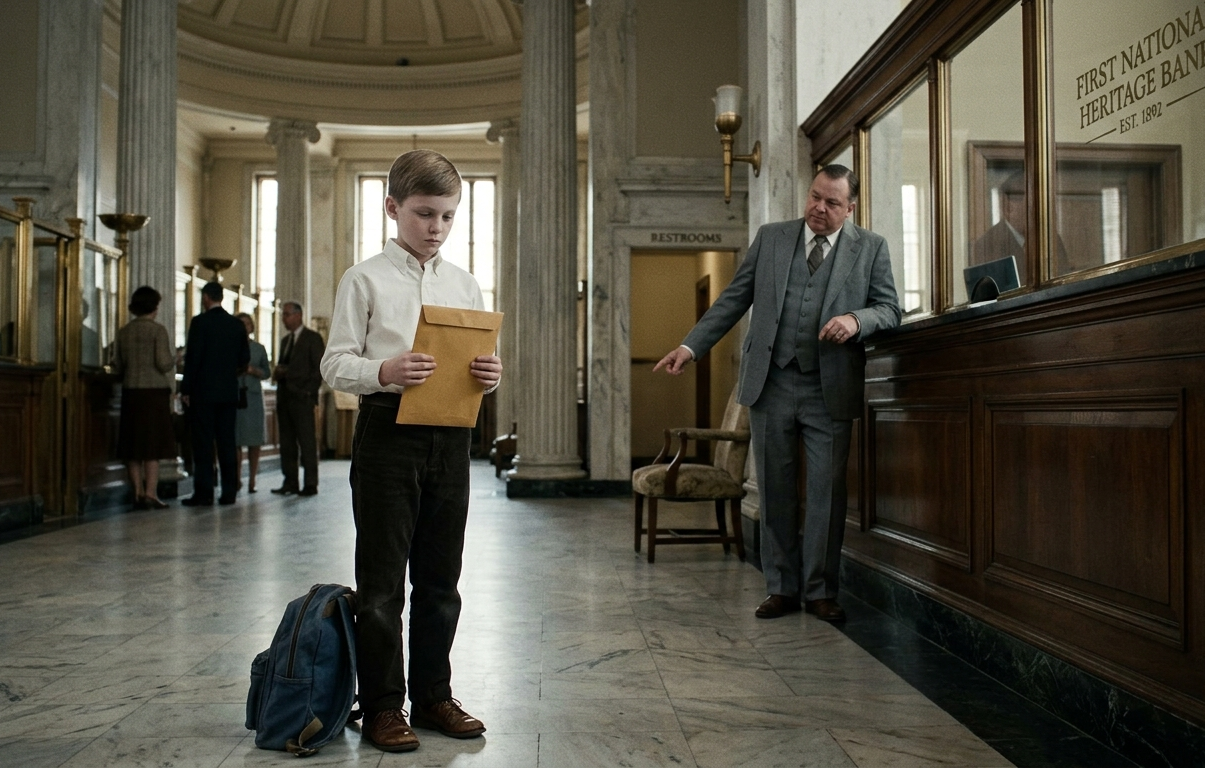
Ten-year-old Wesley Brooks stood quietly inside the grand lobby of First National Heritage Bank, tightly holding a small brown envelope as if it carried the weight of his whole world.
His hands shook slightly—not because he was scared, but because he knew this moment mattered.
Inside the envelope were the final things his grandmother, Eleanor Brooks, had left for him: a handwritten note, a bank card with his name printed on it, and legal papers for a savings account she had opened on the day he was born.
Eleanor had always lived a simple life. She never bought expensive things, never traveled far, and drove the same old car for years. Every winter she wore the same faded gray coat, carefully sewing it whenever it tore.
But month after month, she quietly added money into Wesley’s account.
“One day,” she often whispered to him, “this money will open doors I never had the chance to walk through.”
That cold Monday morning, Wesley wore his neatest shirt and the secondhand shoes his grandmother had purchased for just two dollars. He had cleaned and polished them himself because he wanted to look presentable.
Important.
As he stepped up to the counter, the branch manager, Mr. Bradley, looked him over from head to toe—his cheap shoes, his old backpack, his nervous expression.
Then he pointed toward a chair near the restroom.
“You can sit over there,” he said flatly. “Your uncle can deal with this once he arrives.”
Wesley lowered his eyes and quietly nodded.
He didn’t complain.
He never did.